Average Reviews:

(More customer reviews)I bought this unit for a friend and spent 7 hours straight on it whilst changing it to Win 7 Ultimate in Spanish and loading it with drivers, utilities, software and then tweaking, so this is the extent of my knowledge.
I own a Lenovo S103t that seems near identical in usage, but it is quite different and this is what I would most like to share with folks who are contemplating the purchase of the Gigabyte (GB) unit.
The GB is superbly well built, IMO.
It felt solid, looked smart and was a pleasure to use the entire time.
It is not quite as fast (tiny difference) as the Lenovo, by way of it sporting an N280 CPU, rather than the N450 which is a lot more suited for Win 7 systems.
The actual power difference is only 5% to 10% but the N450 seems to have superior communication with the SATA hard drives.
That being said, the GB was still quick enough and should not factor into the decision to purchase it or not, unless there was an identical model with the N450, at the same price.
I could go through every component and make comparisons but the truth is that both the GB and the Lenovo units are excellent in virtually all aspects.
So allow me to explain the major differences and why these differences would play a major role in deciding if you want to buy the GB.
The touchscreens are as different as oil and water.
One is resisitive and the other is capacitive.
The results of that difference is that one (the GB) is stylus friendly and the other (the Lenovo) is finger friendly. The GB would be (IMO) a more professional business type machine, which excels in handwriting. If you want to hand write documents or sign them with precision, the GB is a better choice. The Lenovo can do it too with a special stylus, but not as well.
On the other hand, the Lenovo's capacitive screen allows for 2 finger touch which allows you to use many apps that require that capacity.
The ability to expand and/or shrink internet pages and/or photos by simply reaching out to the screen and spreading two fingers to expand and closing your fingers to diminish size, is absolutely marvelous, practical and lots of fun too.
So that is the big difference between the two. If you are wondering why the Lenovo is chosen as a comparison, it is because it is one of the few machines in this class (10 inch netbook) that has a capacitive screen. In short, the GB is still fun to use but specializes in business usages. The obvious example of the advantage of a resistive screen that works so well with a stylus, is when someone sends you a document that is to be signed, rather than printing it out, signing it then scanning it to send it back, the GB would allow you to simply sign it on screen and then send it back. Also, students appear to be attracted by the idea of being able to scribble notes in class on resistive screen units. For me, the choice is quite simple. If I want to play with my netbook, I prefer the capacitive screen from the Lenovo, so as to operate it in a similar fashion as iPhones and iPads. If I am looking for professional usage, the GB is the best choice. Both units offer much greater value than one would expect to get at that price. ($375 for the GB) Both units have excellent keyboards for their price range, both are fast enough, although not very powerful.(one must pay attention to not keep too many things open at the same time, lest the computer slow down in a serious way. Having 12 webpages open, along with two Messenger programs and Skype, is sufficient to slow it down. The next page you open will take twice as long as usual.)
Hopefully, I have explained the differences well enough to benefit anyone considering the purchase of a touchscreen netbook.
The other factor that should be mentioned is the 4 cell battery, vs the 6 cell models, which clearly go longer without being plugged in.
The 4 cell unit could probably squeeze out 4 hours, while the 6 cell might surpass 6 hours.
CONCLUSION.
If you have made the right choice and want a business type touchscreen netbook, the GB is superb and I would highly recommend it. It's beautiful classy looking, solid and functional computer.
It is the type of computer one feels proud to open in public and it attracts attention from everyone around.
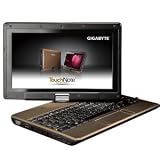
Click Here to see more reviews about: Gigabyte T1028C 10.1 inch Touch Screen Tablet PC with 3G Module - N280 1.66Ghz / 1024x600 / 1G SDRAM / 250GB HDD / 4 Cell / Windows 7 Starter
Specifications CPU Intel? AtomTM Processor N280 1.66GHz(M1022X) Operation System Microsoft? Windows? 7 Starter Chipset Mobile Intel? 945GSE Express Chipset+ ICH7M System Memory (optional) 1GB SO-DIMM*1 (Max 2 GB) Video Chip Mobile Intel? 945GSE Express Chipset+ ICH7M LCD 10.1" Touch TFT-LCD WXGA, 1024x600 with LED backlit HDD (optional) 2.5" 9.5mm SATA HDD 5400rpm, 250 GB I/O Port USB(2.0)*3, Mic-in, Earphone-out, D-Sub, RJ45, 4-in-1 card reader (SD/MMC/MS/MS Pro), Express Card, DC-in Audio Speaker 1.5 watt*2, internal mic-in Bluetooth Built-in V2.1+EDR Webcam 1.3M pixels webcam LAN Ethernet 10/100BASE-T Wireless LAN 802.11b/g/n, 802.16 WiMAX(optional) 3.5G Module HSDPA support (M1022G) Battery Li-ion 4 cells, ~4500mAh Battery Dimension 265(W) x 214(D) x 41.4(H)mm Weight 1.48kg (with 6-cell battery)
 Get 39% OFF

0 comments:
Post a Comment